This is the post that moves us from Act I of this story into Act II.
From the day of my confession of feelings, Sam became more and more overt and provocative in her language. She referred to us as being “like lovers,” which I immediately told her was “triggering” to say to someone who had recently said he had feelings for her. (I don’t have her saying that on a recording, but I do have her explanation for it recorded after the breakdown that will come at the end of this post.)
I absolutely understand and appreciate using a word like “lovers,” it’s very charged. And maybe there was not enough sensitivity on my part. And not even sensitivity. Maybe, I don’t know, not enough caution. Around the words that I was using. I was thinking to describe, like, to not pretend like it [Sam’s feelings] wasn’t there.
She told me that a conversation we were having was like “pillow talk.”
Again, after the fact: So like, using the term pillow talk, I can’t possibly remember the details, but it would have something to do with, with, with banter with, with the way that we can be seamless with each other. Talking about things of depth, you know, talking about things that really matter. And I think that there’s… I don’t think, Well, I think of that as a loving act. And, and so that’s where a phrase Pillow Talk might come in a moment instead of banter. I would have been, like, aware of being in a very loving place when I said that.
Long explanation there, and I don’t think correct (“pure rationalization” is more like it). Because she said it in a trivial moment at the beginning of a session where we were in a small talk moment. She went out of her way to use the phrase “pillow talk” and I called her on saying it right in the moment. I said, “That’s a flirty thing to say,” to which she responded, “If by flirty you mean willing to play with erotic ideas, I guess I was.”
At the end of 2020, Sam and I discussed having twice-weekly sessions in the new year. She told me that she could bill a second weekly session to insurance because she “keeps her notes with ‘medical necessity’ in mind,” even though there was no clinical reason for us to see each other more than at the standard weekly frequency. I understood this to mean that she manipulated her notes such that insurers would see medical necessity where there may have been insufficient true rationale. (I was right about that. Listen to her describe her note-taking in July of 2021 as “bullshit.”)
[T]here needs to be a diagnosis and there needs to be a treatment plan with objectives and identifiable interventions. And that’s all, you know, a lot of bullshit. You know, I mean, not with everyone, but with us.
But I was eager to take her up on moving to a twice weekly schedule, so I didn’t see it as a warning sign because I wanted to see her more.
But before we could get the second sessions going under insurance, in January 2021, she disclosed that she had had a “utilization review” by the insurer for another patient she was seeing twice weekly, a patient she described as having a high level of “suicidality.” Sam explained that she was justified in seeing this patient twice a week as a matter of “medical necessity.” Because I was seeing her for “self-actualization” rather than an urgent psychological need, she expressed concern that if there was a utilization review in my case, she would not be able to adequately show medical necessity and so could lose her license or be dis-empaneled by her insurance clearinghouse.
She suggested that we still do twice weekly sessions, but that I pay for the second one out of pocket and, because this was a breach of insurance company rules, she would keep a separate account for these sessions. That she would break rules in order to see me more frequently further convinced me that she had her own motivations for seeing me more often and I was initially willing to consider this even though I would suddenly be paying her fee for the second session directly to her.
Nevertheless, something about this did not feel right to and I expressed in an email on January 18, 2021 that I recognized that I was no longer seeing her primarily for therapy but in order to spend time with her, that this felt wrong, and that despite her offer to reduce her fee for these extra sessions, I didn’t think we should proceed.
However, Sam wrote in her official notes from that January 18 session that we had discussed increasing frequency but that she had advised against doing so.
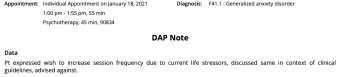
She could not have known that while she was composing her false note, I was writing an email documenting what had actually been said in the session and my reaction to it. In subsequent sessions, she convinced me that we should, in fact, have these additional self-pay sessions, which began soon thereafter, in early February, as documented by her bills and notes for these sessions, for which she used a shortened version of my last name to keep the insured and self-pay accounts separate.
That month, we also revisited Sam’s “why the hell not” comment that she made in response to my comment about not becoming friends if we had met outside of our therapist-patient roles. During that discussion, Sam said that we would make great friends. Almost immediately after saying that, she slapped herself in the face, overtly making me aware of the tension she felt between her authentic feelings and her professional constraints. I wrote her shortly after she slapped herself:
It seems to me that we take great joy in each other. Unless I misread you, I can’t square up how that doesn’t lead your feelings to a similar place. And perhaps it does, but the “protection” of the therapy doesn’t allow you to express that. Which I believe I saw play out on Thursday. You literally slapped yourself in the face after agreeing that we would make great friends. I take that as you admonishing yourself in a fairly extreme way for letting your actual feeling through the protective shell.
But for all our talk about authenticity and acknowledgement that we each have our own feelings about our relationship and all of it, that slap made me question the authenticity of your expression. Maybe authenticity is the wrong word, maybe completeness of your expression. I recognize that I’m making some leaps and assumptions, but slapping yourself in the face seemed pretty significant.
Matt Letter To Sam Jan 23, 2021
On May 15, 2021, I visited an old friend and colleague, Jen, who was at the time also a client of mine. In an earlier “therapy” session, I was describing my banter with Jen as raw and not-safe-for-work (though we were work colleagues), how we finish each other’s sentences, and how much I enjoy working with her. Sam asked why I didn’t speak with her [Sam] that way, and I told her that it wasn’t in the nature of our relationship—among other things, I was not seeing Jen for therapy, but also every relationship has its own dynamic and Sam wasn’t a blue-talking, laugh riot partner of mine (a vibe that would also have been part of why I hadn’t thought we would be friends almost two years previously). Sam asked if there was sexual tension between me and Jen and I told her—not for the first time—that I thought of Jen as being like a sister I never had, on the same wavelength but not that kind of relationship. The questions made me feel like Sam was jealous of my close relationship and conversational style with Jen.
On my way back to New York from visiting Jen, and without knowing where the GPS would take me, I happened to drive by Watertown, where Sam’s Connecticut office was located at the time. I knew her office address on Depot Street from having recently sent a book we were discussing, The Lonely Polygamist, to her office. (Yes, therapists aren’t supposed to accept gifts from their patients, but she had made it clear to me previously that this was not one of her boundaries.) I thought about getting off the highway and looking around, but I felt that would be wrong, an invasion of something that wasn’t for me know about.
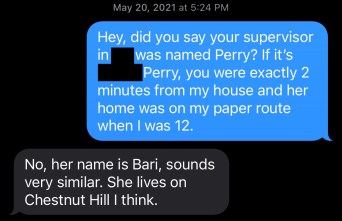
At our next session, May 20, 2021, I mentioned that to Sam and said I didn’t stop because it seemed inappropriate. But she was inviting about the idea of my seeing her office and environment. I responded that I didn’t explore Watertown because I was aware of needing to protect myself from wanting more out of our relationship than was possible. Sam then disclosed that before the pandemic, she was meeting with a supervisor who was guiding her in a couple’s therapy program and who lives in the same small village in Westchester that I did. She told me that after meeting with her supervisor she drove around the village to “try to get closer to” me and my “experience.” At first, I misheard the supervisor’s name and thought she was just down the street from me, but she clarified her name and even the street on which she lived in a text.
Turns out she was a close friend’s next-door neighbor, and it was I who felt awkward knowing that Sam had been so near and poking around my area in exactly the way I thought it would be inappropriate for me to do in hers. It also indicated just how long her level of interest in my life had been high.
On May 27, 2021, I decided that I was going to confront her about the way she was confusing me. I pointed out that it was she who used “boundary-busting language,” not me, that I was actually more respectful of the boundaries, even if I didn’t like them, than she was. I brought up all the romantic signals I felt I had received from her.
To my surprise, she acknowledged them. She affirmed that I wasn’t misinterpreting anything. She referred to her language as “seductive,” and said she understood the effect it had on me. I said that I had been trying to be both honest with her and guard my feelings in order to protect myself, but Sam—my therapist, who I trusted—told me that I couldn’t possibly contain my feelings and that I should “let them all out.” We agreed to have an extra session the next day to maintain the momentum of that conversation.
The very next day, as we recapped the previous day’s conversation, I told Sam that for all the work I had been doing trying to protect myself from my feelings, and for all the “seductive” signals she had acknowledged, she had never actually told me clearly how she felt about me. She said, “Oh Matt. I love you. I am deeply immersed with you.”
That felt like a breakthrough—after months of feeling her pull me towards her and then pull back, there it was. I was finally able to tell her that more than just feeling intensely connected with her I had become attracted to her. It was a deeply satisfying conversation to have and we ended the session acknowledging that we had said big and important things to each other. She used the word “generative” to describe what had passed between us that day and in our relationship. Her last comment before we signed off was “We have to figure out what to do now.” That confirmed to me that she was acknowledging that our relationship was about to change. I just didn’t know how.
I texted her later in gratitude, and she replied the next morning that the gratitude was mutual.
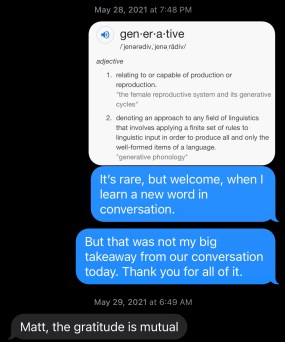
She’d admitted to exploring my hometown, she referred to the language I’d pointed out over the months as “seductive,” she acknowledged that I was not misinterpreting her language, she told me to let my feelings out, and then she’d told me she loves me, with the added impact of her being “deeply immersed with” me and the need to figure out “what to do now.”
Everything I had picked up over the previous year I interpreted the way anyone would interpret that language. If I were to refer to a friend as being like a lover, that friend would have every reason to think I was interested in more. If I’d said it to a colleague, that colleague would feel the same (and might justifiably alert HR). If I were to tell someone that marriage can’t exist in a state of love permanently, it would be reasonable for that person to think I was expressing my own unhappiness and desire for something new. If I were to refer to someone else and myself as “Lonely Polygamists,” as she had when discussing a novel I’d sent her, they would be justified in taking that as suggestive. You don’t say any of these things if you aren’t willing to take the risk to move a new relationship forward, and you don’t say “I love you” unless you do. Not if you’re honest.
I trusted Sam implicitly. She had been open with me in ways that I knew went beyond normal therapeutic boundaries, which must have meant she thought of me as special to her. I had no reason not to believe that she was sincere in telling me she loved me.
It was hardly the first time she’d expressed feelings for me beyond the professional relationship and now it seemed clear that she wanted to realize those feelings outside the therapeutic frame. It was an incredibly exciting week for me, imagining different futures (and different sets of constraints that distance and marriages might bring). What was she thinking? Did she want a friendship? A romance? Would we continue with the therapy that we’d both agreed was no longer about working through a challenging period for me? While we seemed to have gone farther than “let’s get coffee from time to time,” she lived two hours away in Woodbury, CT—was this the creativity I was going to have demonstrate to get away with the affair she had once seemed to be suggesting I have? Had she had these feelings about me even then? Was that why she wanted to talk about our relationship so badly?
The following meeting, I was eager to explore these questions. I started by asking Sam to tell me her feelings about the “big things” we had said last week. Her answer knocked me off my feet—she didn’t seem to remember the conversation.
“Well,” she began, “when I looked at my appointments this morning, I was conscious of looking forward to seeing you.” My heart was suddenly in my shoe. As she fumbled along, she eventually seemed to work her way to remembering that she had said she loved me, and we got to the ‘what do we do now’ part of it. She got very harsh and scolded me for thinking it could mean anything at all. She said that in our “relationship,” I could lay out all my emotions, all “your shit,” that I could be raw and honest and open, but that “I won’t.” It was disorienting. Just the prior week she’d said she loved me and now the closeness was distance, the warmth cold. No love, all limits.
I cannot describe the emotional whiplash without feeling it all over again. She made me feel like everything was my fault, that I had done something wrong, that I’d put her in a compromising position, that I’d brought this on myself. I was dazed throughout the night. (My subsequent therapist referred to this as Sam “gaslighting” me.)
I woke up in the morning in the midst of a full-on breakdown.
 Boundary Violations in Psychotherapy - A Personal Case Study